
The Galapagos Giant Tortoise: Lifespan, Habitat and How Many Are Left
Discover the Galapagos tortoise, one of the longest-lived reptiles on land. Learn about its unique adaptations and threats to its survival.Table of Contents
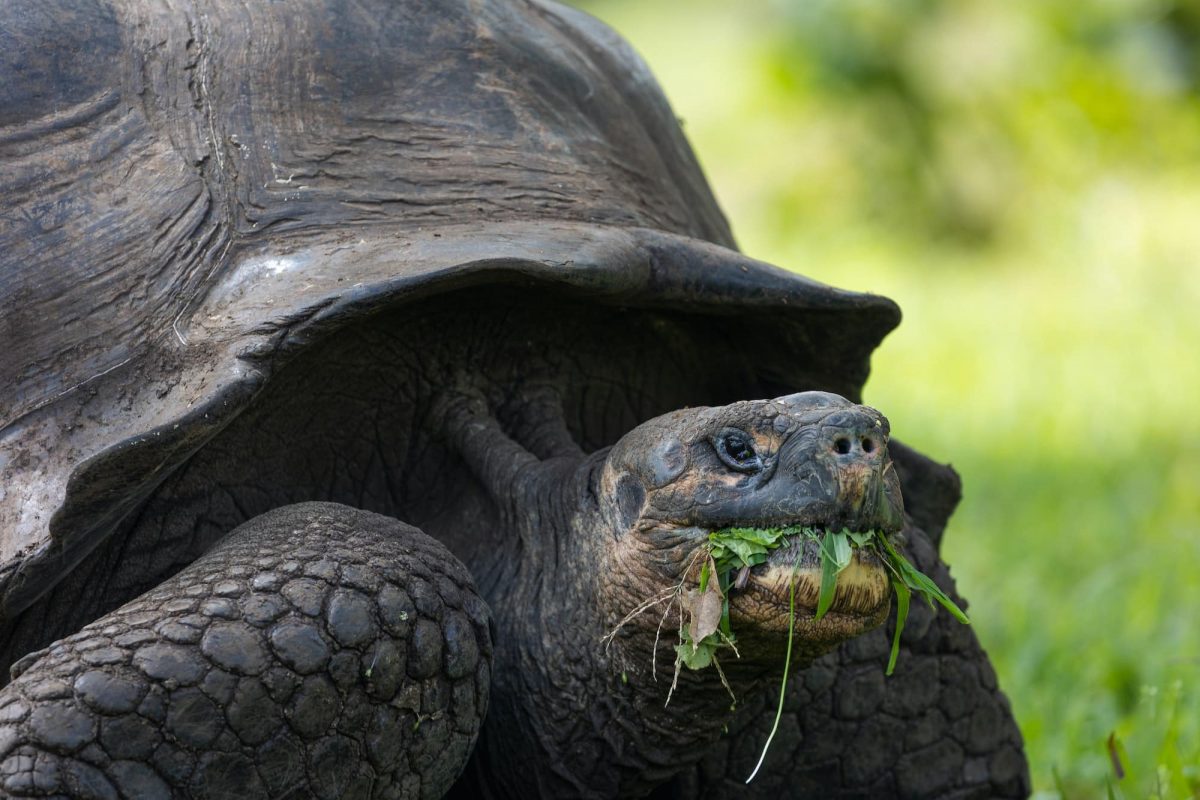
The Galapagos giant tortoise is the animal that gave the islands their name: galápago is an old Spanish word for tortoise. Today these gentle giants are the largest living tortoises on Earth, they can live well over 100 years, and they are one of the easiest Galapagos animals to see up close on any trip.
In this guide we answer the questions travelers ask most: how long Galapagos tortoises live, how big they get, where they live, what they eat, and how many are left in the wild today. You’ll also find every species with its conservation status, the story of Lonesome George, and the best places to see giant tortoises during your Galapagos cruise or land-based tour.
Galapagos tortoise quick facts
| Fact | Answer |
|---|---|
| Scientific genus | Chelonoidis (one species per island or volcano) |
| Lifespan | 100+ years in the wild |
| Average weight | About 250 kg (550 lb); the largest males reach about 400 kg (880 lb) |
| Average length | About 1.5 m (5 ft) shell length |
| Species | 15 identified, 2 of them extinct |
| Wild population | An estimated 20,000–25,000 tortoises |
| Where to see them | Santa Cruz highlands, breeding centers on Santa Cruz, Isabela and San Cristóbal, and visitor sites on Isabela and San Cristóbal |
Galapagos Tortoise Lifespan: How Long Do They Live?
Galapagos tortoises are among the longest-living vertebrates on the planet. In the wild they regularly live more than 100 years, and individuals in long-term care have lived far longer. The Galapagos Conservation Trust gives an average lifespan of 100+ years.
Why do they live so long? A very slow metabolism, a diet of low-energy plants, long hours of rest (about 16 hours a day) and the absence of natural predators for adults all play a part. Once a tortoise survives its first vulnerable years, very little in its natural environment can harm it.

When do Galapagos tortoises reach maturity?
Galapagos tortoises grow slowly and take decades to reach adulthood. Most reach sexual maturity at around 20–25 years of age. Young tortoises raised in breeding centers are usually returned to the wild at about 5 years old, when they are big enough to survive introduced predators, but they still have many years to go before they can breed.
Galapagos Tortoise Size and Weight
The Galapagos giant tortoise is the largest living tortoise in the world. Adults weigh about 250 kg (550 lb) on average, and the biggest males reach around 400 kg (880 lb). The average shell length is about 1.5 meters (5 feet), with the largest individuals reaching 1.8 meters.
Males are much larger than females, and size also varies by species. Domed tortoises from the humid highlands of Santa Cruz and Isabela tend to be the heaviest, while saddleback tortoises from drier islands such as Española are smaller and lighter.
Where Do Galapagos Tortoises Live? Habitat
Galapagos giant tortoises live only in the Galapagos Islands, the volcanic archipelago about 1,000 km (600 miles) off the coast of Ecuador. Today wild populations are found on Santa Cruz, Isabela (on five of its volcanoes), San Cristóbal, Española, Santiago, Pinzón and Fernandina, and tortoises have been returned to Floreana and Santa Fe as part of restoration programs.
Their habitat ranges from the dry, cactus-covered lowlands to the green, misty highlands. Many tortoises move between the two during the year: they spend the cool, dry season in the highlands, where there is more vegetation and moisture, and come down to the lowlands to nest. You can read more about the islands’ two seasons in our Galapagos weather by month guide.
Domed vs. Saddleback Tortoises
The shape of a tortoise’s shell tells you a lot about where it lives:
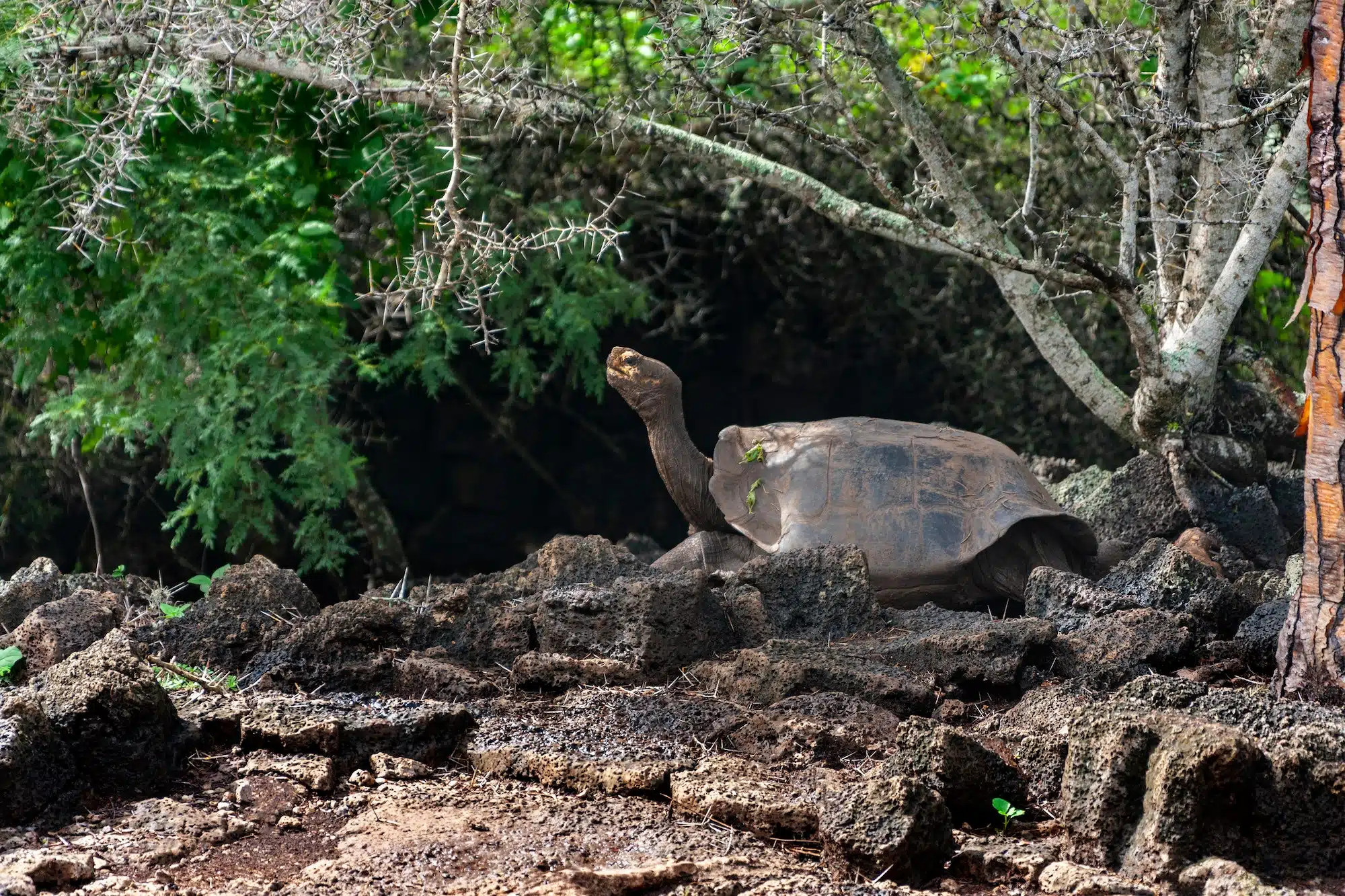
- Domed tortoises have a rounded shell with no upward angle at the front. They live on large, humid islands and volcanoes with plenty of low vegetation, such as the Santa Cruz highlands and Alcedo Volcano on Isabela, where food grows close to the ground.
- Saddleback tortoises have a shell that curves up at the front, like a saddle. This lets them stretch their long necks up to reach higher plants such as cactus pads. They live on smaller, arid islands where food is scarce, such as Española and Pinzón.
Some species have intermediate shells. This variation from island to island is one of the clearest examples of adaptation in the archipelago, and it helped inspire Charles Darwin’s ideas on evolution in the Galapagos.
Galapagos Tortoise Adaptations
Galapagos tortoises are built to survive on remote volcanic islands with long dry periods:
- Water storage: they can store large amounts of water in their bodies and can survive for many months without eating or drinking. This is also why sailors once kept them alive on ships as a source of fresh meat.
- Slow metabolism: they use very little energy and rest for most of the day, which helps them survive when food is scarce.
- Shell shape: domed shells suit dense, low vegetation, while saddleback shells and long necks let tortoises reach higher food on dry islands.
- Seasonal migration: many populations walk between the lowlands and highlands following food and water, often using the same routes for generations.
- Partnerships with birds: Darwin’s finches and mockingbirds pick ticks and parasites from the tortoise’s skin. The tortoise stretches its neck and raises its body so the birds can reach.
Galapagos Tortoise Diet and Behavior
What do Galapagos tortoises eat?
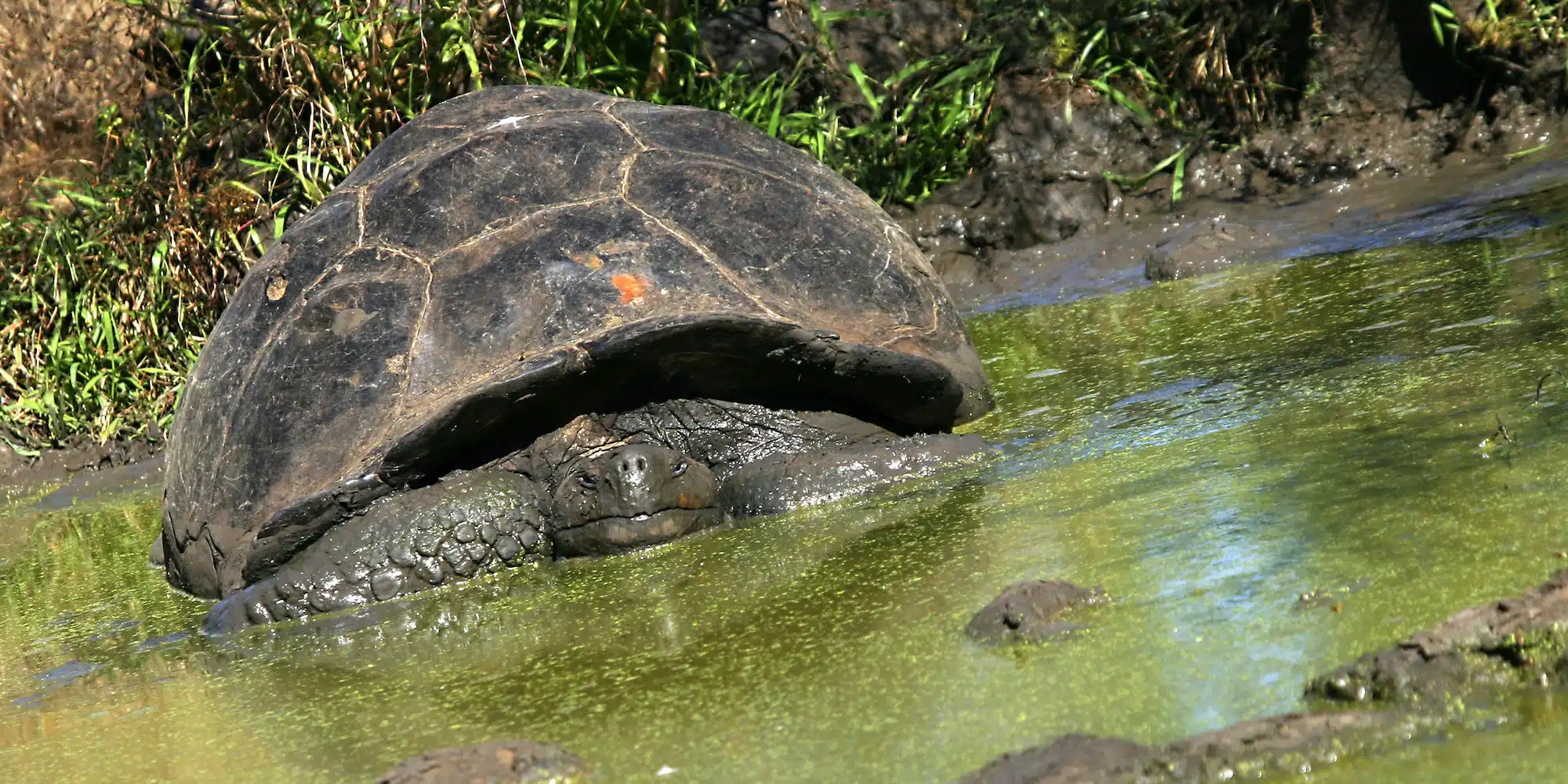
Galapagos tortoises are herbivores. They eat grasses, leaves, fruits, flowers and cactus pads, depending on what grows where they live. On dry islands, prickly pear cactus (Opuntia) is a key source of food and water, and it is no coincidence that the cactus grows taller on islands with saddleback tortoises. Tortoises get most of the water they need from the plants they eat and drink deeply from pools and puddles when they find them.
Do Galapagos tortoises hibernate?
No. Galapagos tortoises do not hibernate. Like all reptiles, they rely on the environment to control their body temperature: they bask in the sun in the morning to warm up and rest in the shade, in mud wallows or in shallow pools when it gets hot. During harsh, dry conditions they can stay inactive for long periods to save energy. Many also migrate to the cooler, greener highlands during the dry season, roughly from July to October, according to the San Diego Zoo Wildlife Alliance.
Are giant tortoises dangerous?
Galapagos giant tortoises are not aggressive toward people. They are calm, slow animals that will usually pull their head and legs into their shell with a loud hiss if they feel threatened. Males can be aggressive with each other during mating season, when they compete by stretching their necks up to see who stands taller.
That said, an adult can weigh several hundred kilograms, so it is important to give them space. Galapagos National Park rules ask visitors to keep at least 2 meters (6 feet) from wildlife and never to touch or feed animals. See our 14 Galapagos Park rules before you go.
Are Galapagos tortoises social?
Galapagos tortoises are mostly solitary but not territorial. You will often see several tortoises grazing in the same meadow or soaking together in the same pond, especially in the highlands, because they gather where food and water are plentiful rather than because they form social groups.
Reproduction and Hatchlings
Galapagos tortoises breed mainly during the hot, wet season, from about January to May. Males make loud, deep grunts while mating, one of the few sounds these quiet animals make.
After mating, the female walks to a dry, sunny nesting area in the lowlands, digs a hole with her back feet and lays between 2 and 16 round eggs, each about the size of a tennis ball. She then covers the nest with soil and urine, which hardens into a protective cap. The sun incubates the eggs, and the young hatch after around 130 days, according to the Galapagos Conservation Trust.
The temperature of the nest decides the sex of the hatchlings: warmer nests produce mostly females and cooler nests produce mostly males. Researchers from the Charles Darwin Foundation found that a difference of only 50–100 meters in nest elevation on Santa Cruz can shift the result from mostly female to mostly male, which is why breeding centers control incubation temperatures carefully.
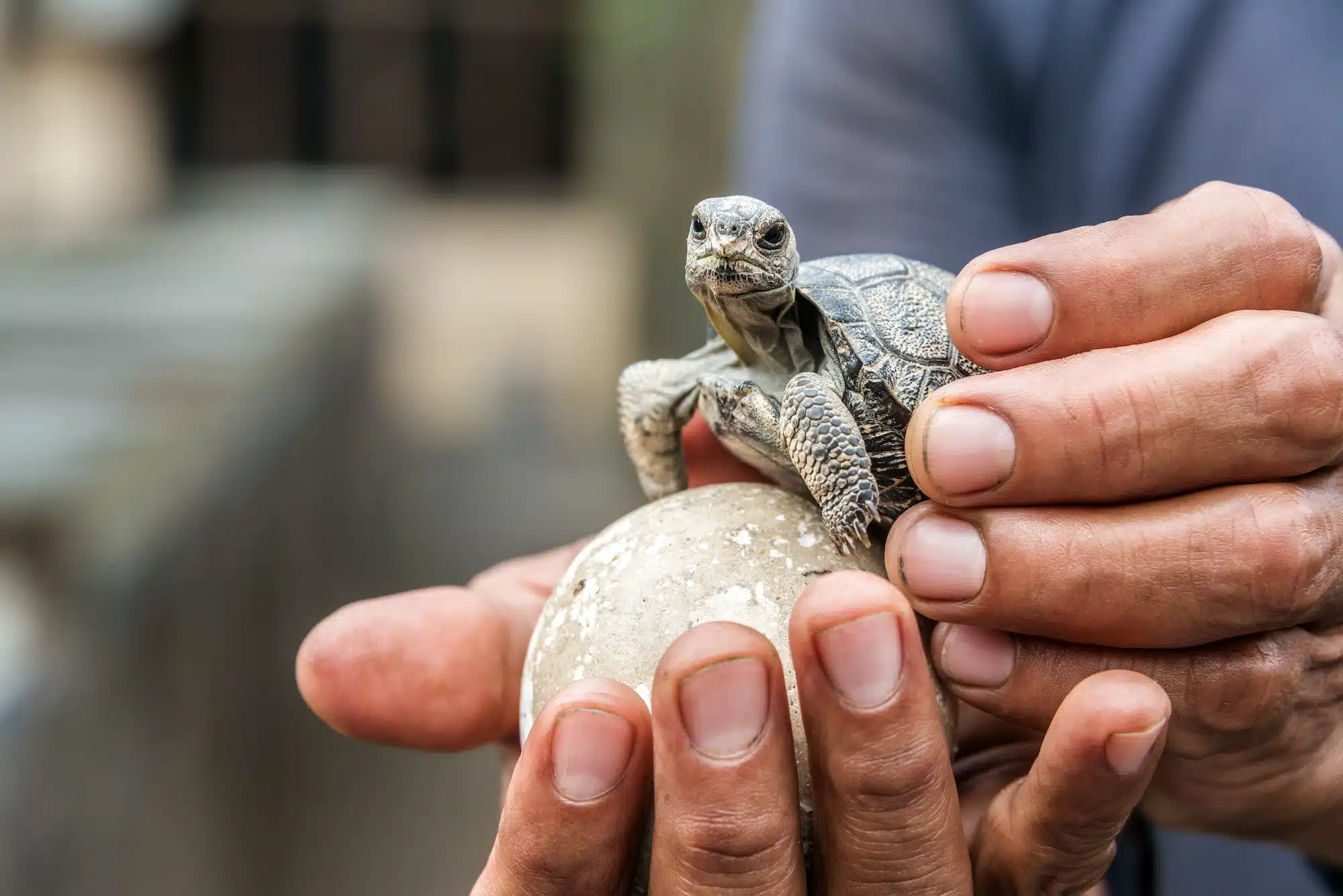
Hatchlings dig their way out of the nest and are on their own from day one. Their first years are the most dangerous: before introduced animals arrived, the main natural predator of young tortoises was the Galapagos hawk.
Galapagos Tortoise Predators and Threats
Adult Galapagos tortoises have no natural predators. Their size and shell protect them from every native animal in the islands. The threats they face today were brought by people:
- Historic hunting: pirates, whalers and fur sealers took tortoises by the thousands as fresh meat for long voyages (see History below).
- Introduced animals: rats, pigs and fire ants eat eggs and hatchlings, pigs dig up nests, feral dogs can attack tortoises, cattle and horses trample nests, and goats compete with tortoises for food.
- Habitat change: farms, fences and roads in the inhabited highlands can block old migration routes between nesting areas and feeding grounds.
Most of these threats are now managed by the Galapagos National Park and its partners, and several introduced species have been removed from entire islands (see Conservation below).
How Many Galapagos Tortoises Are Left?
An estimated 20,000–25,000 giant tortoises live in the wild in the Galapagos today, according to Galápagos Conservancy. Historically, there were many more: between 100,000 and 200,000 tortoises were lost to hunting and introduced species after humans arrived in the islands, a decline of roughly 75–90%.
The good news is that numbers are growing again. Decades of breeding, repatriation and invasive species removal have brought several species back from the edge. On Española, only 14 adult tortoises remained (2 males and 12 females). Together with a third male, Diego, who was returned from the San Diego Zoo in 1976, they became the founders of a breeding program that has since returned nearly 2,000 young tortoises to the island.
Galapagos Tortoise Species and IUCN Status
Scientists have identified 15 species of Galapagos giant tortoise, each from a different island or volcano. Of these, 6 are Critically Endangered, 3 Endangered, 3 Vulnerable and 2 Extinct on the IUCN Red List, and the Santa Fe tortoise disappeared before it could be formally named.
| Species | Where it lives | IUCN status |
|---|---|---|
| Western Santa Cruz tortoise (C. porteri) | Santa Cruz, western highlands | Critically Endangered |
| Eastern Santa Cruz tortoise (C. donfaustoi) | Santa Cruz, Cerro Fatal | Critically Endangered |
| Española tortoise (C. hoodensis) | Española | Critically Endangered |
| Santiago tortoise (C. darwini) | Santiago | Critically Endangered |
| Fernandina tortoise (C. phantasticus) | Fernandina | Critically Endangered |
| Sierra Negra tortoise (C. guntheri) | Isabela, Sierra Negra Volcano | Critically Endangered |
| San Cristóbal tortoise (C. chathamensis) | San Cristóbal | Endangered |
| Cerro Azul tortoise (C. vicina) | Isabela, Cerro Azul Volcano | Endangered |
| Darwin Volcano tortoise (C. microphyes) | Isabela, Darwin Volcano | Endangered |
| Wolf Volcano tortoise (C. becki) | Isabela, Wolf Volcano | Vulnerable |
| Alcedo Volcano tortoise (C. vandenburghi) | Isabela, Alcedo Volcano | Vulnerable |
| Pinzón tortoise (C. duncanensis) | Pinzón | Vulnerable |
| Pinta tortoise (C. abingdonii) | Pinta | Extinct |
| Floreana tortoise (C. niger) | Floreana | Extinct |
| Santa Fe tortoise (not formally named) | Santa Fe | Extinct (not assessed) |
The largest populations today live in the Santa Cruz highlands and on Alcedo Volcano on Isabela.
Extinct Species: Pinta Island and Lonesome George
Lonesome George was the last known Pinta Island tortoise. He was found on Pinta in 1971 and taken to the Charles Darwin Research Station on Santa Cruz, where scientists spent decades trying, without success, to find him a mate of his own species. When he died in 2012, the Pinta tortoise was declared extinct. George became a worldwide symbol of extinction and of why conservation matters.
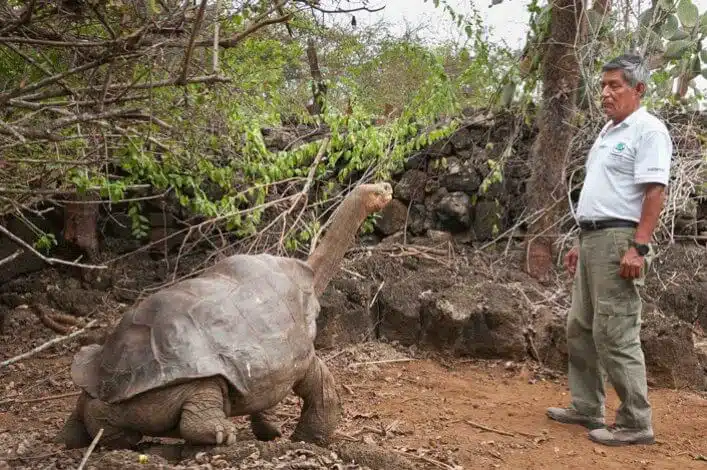
Lonesome George. Photo: Tui De Roy / Charles Darwin Foundation
The Floreana tortoise was hunted to extinction in the 1800s, not long after Darwin’s visit. But its story did not end there: whalers moved tortoises between islands, and scientists found tortoises with Floreana and Pinta ancestry on Wolf Volcano, Isabela. Through a breeding program with these hybrids, tortoises carrying Floreana genes have been returned to Floreana Island, the first giant tortoises to roam there in around 180 years.
The Fernandina tortoise
The Fernandina tortoise was known from a single specimen collected in 1906 and was long thought to be extinct. In 2019, an expedition found a living female on Fernandina, later named Fernanda, and genetic testing confirmed she belongs to the same species. Tracks and droppings suggest there may be more tortoises on the island, and the search continues.
How Did Tortoises Reach the Galapagos?
Galapagos tortoises descend from ancestors that drifted to the islands from mainland South America, around 1,000 km (600 miles) away, most likely carried by ocean currents. Scientists believe they arrived around 2–3 million years ago, either floating on their own or on rafts of vegetation washed out to sea by rivers. Their ability to survive many months without food or water made the long journey possible. Once in the islands, tortoises spread from island to island and evolved into separate species.
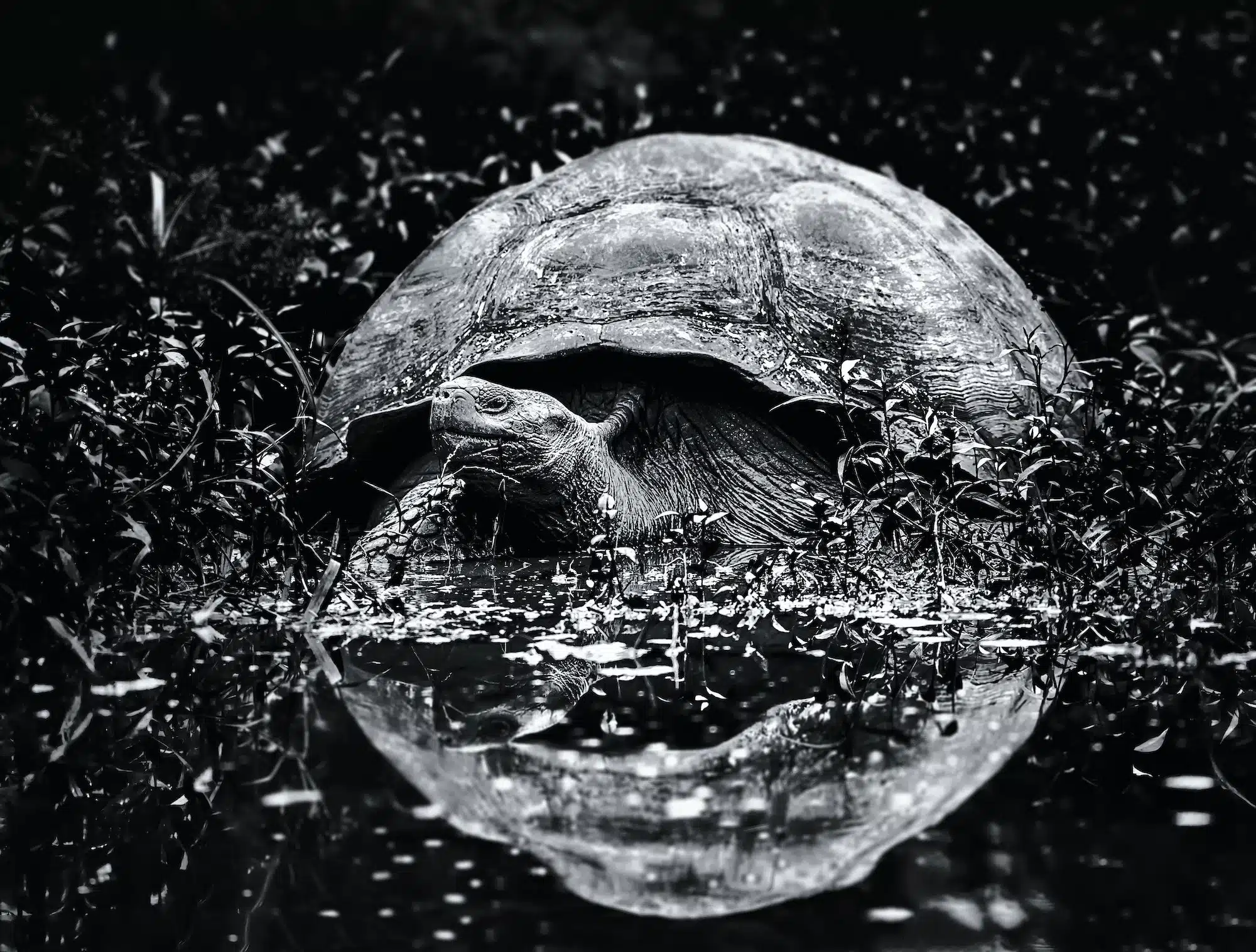
Can Galapagos tortoises swim? No, they are land animals and cannot swim. They can, however, float: they hold their heads up and drift, which is how their ancestors are thought to have crossed the ocean.
History: Whalers, Pirates and Darwin
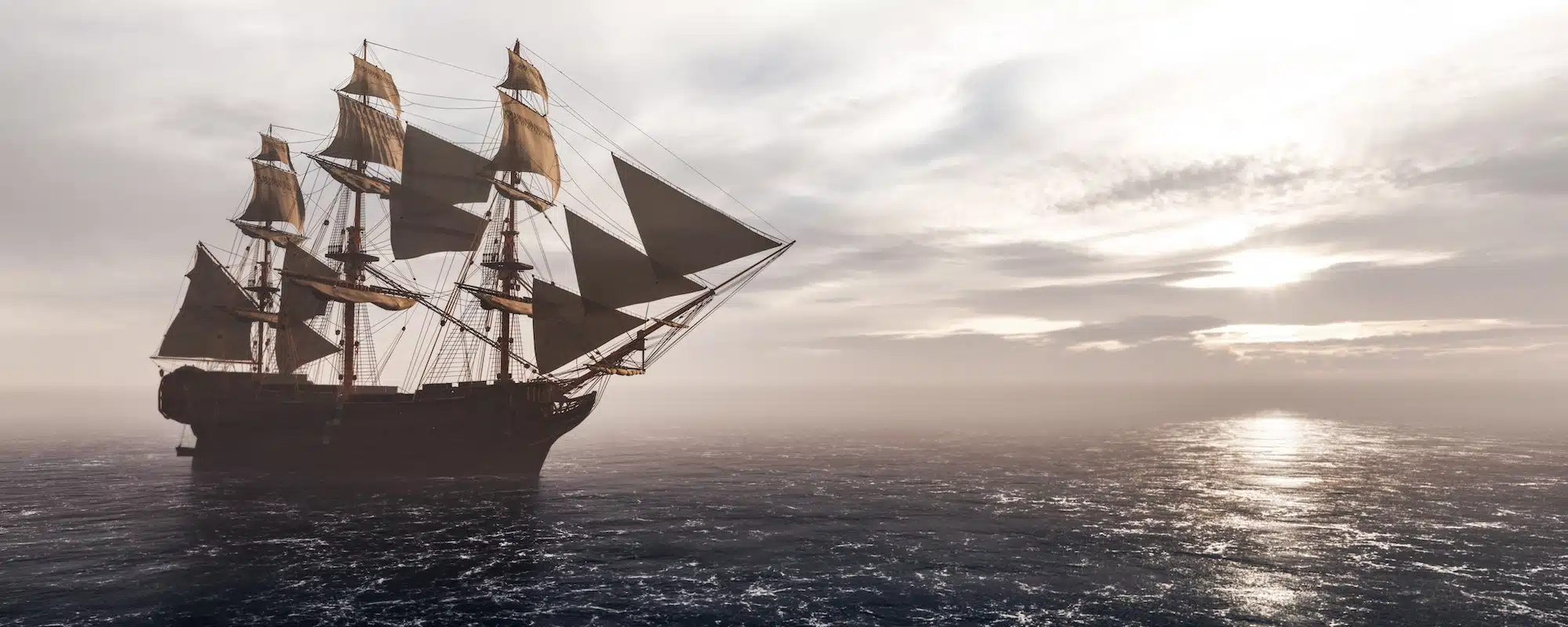
From the late 1600s to the 1800s, pirates, whalers and fur sealers stopped in the Galapagos to collect tortoises. Because a tortoise can survive for months without food or water, sailors stacked them alive in their ships’ holds as a supply of fresh meat for long voyages. Tens of thousands were taken, and several island populations collapsed or disappeared.
When Charles Darwin visited the Galapagos aboard HMS Beagle in 1835, he heard from local officials that people could tell which island a tortoise came from by the shape of its shell. Together with the finches and mockingbirds he collected, these differences between islands later helped shape his theory of evolution by natural selection. Learn more in our article on evidence of evolution in the Galapagos.
Conservation: How Galapagos Tortoises Are Protected
Galapagos tortoises are protected by Ecuadorian law. In 1959, Ecuador created the Galapagos National Park, which today covers most of the land in the archipelago, and the Charles Darwin Foundation was founded the same year. Its research station in Puerto Ayora, Santa Cruz, opened in the 1960s and has worked with the Park ever since to save the tortoises.
The main conservation efforts include:
- Breeding and rearing: eggs and hatchlings are collected from wild nests or bred in captivity, incubated at controlled temperatures and raised in breeding centers until about 5 years old, when they are returned to their home island.
- Removing invasive species: goats, pigs and rats have been removed from several islands, giving vegetation and young tortoises the chance to recover.
- Tracking migration and nests: GPS trackers show scientists where tortoises nest and migrate, so these areas can be protected.
- Restoring lost populations: tortoises have been returned to islands where they had disappeared, such as Santa Fe and Floreana, through the Giant Tortoise Restoration Initiative.
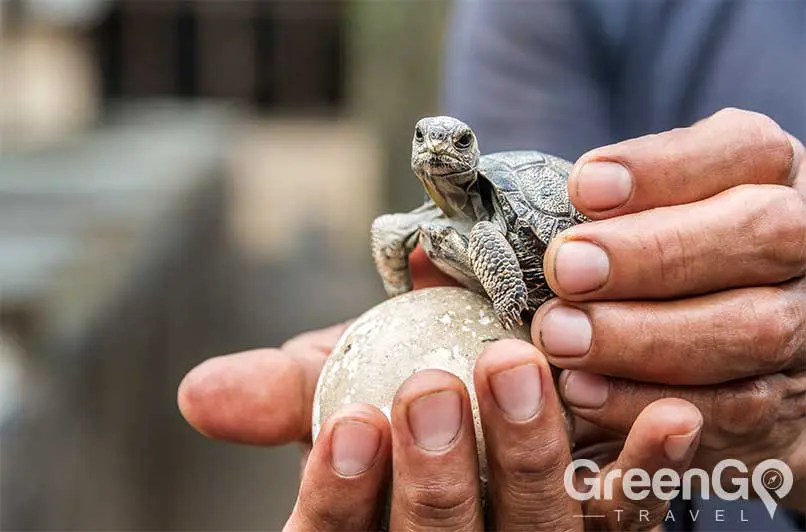
Travelers help too: park fees, licensed guides and responsible tourism fund much of this work. For more on protecting the islands, read about Galapagos Islands conservation and our tips for sustainable travel to the Galapagos.
Where to See Giant Tortoises in the Galapagos
Seeing giant tortoises in the wild is one of the highlights of any trip, and almost every itinerary includes at least one tortoise site. These are the best places:
- Santa Cruz highlands: the best place to see wild tortoises. At El Chato Reserve and the neighboring ranches in the highlands, dozens of tortoises graze in open fields and soak in muddy ponds. Combine it with the Los Gemelos craters nearby.
- Charles Darwin Research Station, Santa Cruz: the Fausto Llerena breeding center in Puerto Ayora lets you see young tortoises at every stage, along with the conservation work behind them.
- Isabela: the Arnaldo Tupiza Tortoise Breeding Center, a short walk from Puerto Villamil through the wetlands, raises the species from Isabela’s southern volcanoes. On cruises, Urbina Bay on the foot of Alcedo Volcano is a good place to spot wild tortoises and land iguanas.
- San Cristóbal: the Galapaguera de Cerro Colorado breeding center in the highlands is home to the San Cristóbal tortoise, and cruise visitors can see tortoises in a more natural setting at Galapaguera Natural.
- Floreana: a small group of tortoises lives in the highlands near Asilo de la Paz, the island’s historic water source. See our Floreana Island travel guide for more.

If you are based on land, Santa Cruz is the easiest island for tortoise sightings, and you can add Isabela or San Cristóbal with an island-hopping tour or an extension such as the Santa Cruz, Isabela or San Cristóbal extensions. On a cruise, most itineraries include the Santa Cruz highlands, and longer 8-day Galapagos cruises often add Isabela’s tortoise sites. Traveling with kids? Tortoises are always a favorite; see our tips for Galapagos family cruises.
Want to plan your route around the best wildlife spots? Our guides to the Galapagos Islands by region and the top things to do in the Galapagos will help, and our list of 21 famous Galapagos animals covers what else you can see along the way.
See Galapagos cruises that visit giant tortoise sites
The Galapagos Tortoise FAQ
Galapagos tortoises live more than 100 years in the wild, making them one of the longest-living animals on Earth.
An estimated 20,000–25,000 Galapagos giant tortoises live in the wild today, down from 100,000–200,000 before hunting and introduced species reduced their numbers. Conservation programs have helped several populations grow again.
Scientists have identified 15 species, each from a different island or volcano. Two are listed as extinct on the IUCN Red List (Pinta and Floreana), and a third, from Santa Fe, disappeared before it was named.
Adults weigh about 250 kg (550 lb) on average, and the largest males reach around 400 kg (880 lb).
They are herbivores and eat grasses, leaves, fruits, flowers and cactus pads. They get most of their water from plants.
Adults have no natural predators. Eggs and hatchlings are at risk from introduced rats, pigs, fire ants and dogs, and young tortoises can be taken by the Galapagos hawk.
No. They cannot swim, but they can float, which is how their ancestors probably reached the islands from South America.
The Santa Cruz highlands, especially El Chato Reserve, are the best place to see wild tortoises. Breeding centers on Santa Cruz, Isabela and San Cristóbal show young tortoises and conservation work up close. Get in touch for more information.